.png?width=1024&height=1024&name=MyFlight%20Forecast%20app%20icon%202%20(1).png)




Today’s flight conditions across the United States present a mixed but manageable picture for...
Turbulence Reporting for April 30, 2026 | MyFlight Forecast
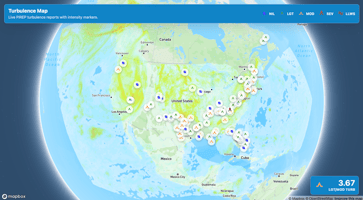
U.S. turbulence forecast for today, April 30, 2026, reflects a dynamic but controlled spring pattern across the country. From the perspective of MyFlight Forecast, today is a strong example of how real-time atmospheric interpretation can turn what looks like a complex weather map into a predictable, manageable flying experience.
Across most major flight corridors, turbulence is present but not dominant. The majority of passengers will experience light chop, with isolated pockets of moderate turbulence driven by regional weather systems, terrain interaction, and jet stream positioning. This is not a day defined by widespread disruption, but rather by localized conditions that can be navigated efficiently with proper planning.
In the Northeast, including key departure and arrival hubs like John F. Kennedy International Airport, LaGuardia Airport, and Logan International Airport, a weak frontal boundary continues to shift offshore. Residual moisture and low-level cloud layers are contributing to light turbulence during climb and descent. Passengers departing this region may notice mild bumps shortly after takeoff, particularly below 10,000 feet. As aircraft climb into higher altitudes, conditions improve significantly, with smoother air dominating above typical cruising levels.
This is a pattern MyFlight Forecast tracks closely, where low-level instability gives way to stable upper-air conditions. For travelers, this means any discomfort is usually short-lived and confined to the early and final phases of flight.
Moving into the Midwest, conditions become more active. Airspace around O'Hare International Airport and extending south toward Texas is influenced by developing convective activity. Temperature gradients and wind shear are contributing to areas of moderate turbulence, particularly in and around building storm systems. While severe turbulence is not widespread, any flight path intersecting active convection may encounter brief but noticeable bumps.
This is where MyFlight Forecast emphasizes route optimization. Aircraft are routinely rerouted around storm cells, and while this may add slight time to a flight, it significantly improves ride quality. Outside of these convective zones, conditions return to light turbulence or even smooth air, reinforcing that today’s turbulence is highly localized rather than systemic.
In the Southeast, including major hubs like Hartsfield–Jackson Atlanta International Airport and Miami International Airport, the atmosphere remains relatively stable. This region is benefiting from more consistent air masses and fewer active weather systems. Passengers flying through the Southeast can expect some of the smoothest conditions in the country today, with only isolated afternoon convection introducing occasional light turbulence.
Out west, terrain plays a larger role. Around Denver International Airport, mechanical turbulence is present due to airflow interacting with the Rocky Mountains. These effects are most noticeable at lower altitudes and on the downwind side of mountain ranges. Aircraft climbing out of Denver or crossing the Rockies may experience moderate turbulence during these phases, but conditions typically improve as flights reach higher altitudes.
Further west along the coast, airports like Los Angeles International Airport and San Francisco International Airport are seeing relatively calm conditions. Coastal marine layers can introduce light turbulence during descent, but overall, the West Coast remains favorable for smooth flying today.
At cruising altitudes across the northern United States, the jet stream is moderately active. This introduces the potential for clear-air turbulence, particularly between typical cruising levels. These pockets are often brief and difficult to predict without advanced modeling, which is where MyFlight Forecast provides value by translating complex atmospheric data into understandable expectations for passengers.
The presence of jet stream energy does not mean continuous turbulence. Instead, it results in intermittent bumps that pilots can often mitigate by adjusting altitude. For passengers, this may feel like occasional, short-lived chop rather than sustained rough air.
From a national perspective, today’s smoothest routes are concentrated in the southern tier of the United States, including flights between Florida, Texas, and the Southwest. The most active routes are those intersecting the Midwest and parts of the Northeast, where weather systems are more influential.
For travelers, the takeaway is straightforward. Expect a mostly smooth flight with occasional bumps depending on your route. Turbulence today is not a defining feature of the flying experience, but rather a manageable element that varies by region and altitude.
MyFlight Forecast continues to focus on making this information accessible. Instead of raw data or technical jargon, the goal is to provide clarity. Whether you are a frequent flyer, a nervous traveler, or simply someone who prefers to know what to expect, understanding turbulence in advance changes the entire experience.
If weather delays or disruptions affect your travel plans today, it may also create opportunities. One-way flight availability and repositioning aircraft can open up options that are not typically visible through traditional booking channels. Monitoring platforms like CharterBlast can provide access to these opportunities in real time.
Today reinforces a key principle in aviation weather. Turbulence is rarely everywhere. It is specific, predictable, and avoidable when you know where to look.